On Character and Business

I got my first taste of the importance of character to our economy as a bank trainee in Atlanta, Georgia in 1980. I was working in the credit card department and expressed amazement that we would issue so much in the way of unsecured credit bound to be highly uncollectable in the event of a default. The response from my supervisor: Our system depends on people’s intrinsic honesty. And that is true. Without honesty, our free enterprise system as we know it would implode. Almost fifty years in finance has shown me what people will do to honor their obligations. A FICO score is basically a statistical measure of honest behavior given so many of us have more credit available than we could readily satisfy. But a FICO score is a comparatively new metric. Through the history of banking, a person’s reputation – character – was effectively their most valued currency.
If you want to learn to lend money, a good place to begin is in a bank training program. And the commercial credit training program is the first step. After taking that first step, I was on my way to becoming a credit geek and eventually a loan officer. I would take that experience with me in a career of real estate net lease and mortgage financing where I would chair investment committees for successive public companies through more than 30 years and $20 billion in commitments.
Not much after the Gilded Age, bank credit and loan professionals began to talk about the Five C’s of credit, viewed to be a framework for extensions of credit. Character is the first of these, followed by Capacity (the ability to repay), Capital (alignment of interest, or how much skin in the game you have), Collateral (the value of pledged assets) and Conditions (the purpose of the loan and the economic conditions supporting the credit thesis).
With character being the first among equals of the Five C’s, a principal takeaway was that you can never do good business with bad people. They are the ones who will not honor their agreements and will readily weasel out in tough times. Fortunately, the vast majority of us are honorable. That’s why our economic system works. And a few set the bar high for honorable behavior, going the extra mile when they didn’t have to.
The list of honorable mentions included JP Morgan, who, acting as if he were a central banker, personally guaranteed loans to otherwise solvent banks to keep them from collapsing in the panic of 1907. Likewise, Henry Ford compensated early shareholders who had sold out too cheaply. Ten years later, he would radically raise the wages of his employees when he had no obligation to. The Japanese have a notion for such exemplary behavior: “shinyo” - trustworthiness and personal honor – a concept that prompts businessmen to repay creditors voluntarily, even after debts have been legally discharged.
In recent times, there have been less frequent public examples of going the extra mile for integrity.
Faced with a crisis caused by criminal tampering with its packaging, Johnson and Johnson memorably recalled 31 million bottles of Tylenol in 1981 at a cost that would equate to more than $300 million in 2026 dollars. The reflexive speed with which the company made this courageous and costly commitment is a gold standard of going the extra mile for integrity, in this case to support customers.
At the end of August 1991, Warren Buffet agreed to become interim chairman of investment banking firm Solomon Brothers. He was a major investor in the company, whose very existence was threatened due to rules violations associated with auctions of government securities. His personal skill and reputation for integrity proved critical in saving the threatened firm, which would eventually be sold to Travelers Insurance and merged with Citigroup for $9 billion six years later. At the outset of assuming an unpaid job he had not sought, Warren Buffet said this to his new employees:
“Lose money for the firm and I will be understanding. Lose a shred of reputation and I will be ruthless.”
This admonition from the noted investor whose famous two investing rules were: “1. Never Lose Money and 2. Never forget rule number 1.” But of course, not even Mr. Buffet has been immune to investing losses, making this couplet a cautionary admonition. The one non-negotiable pertains to character and the indispensable and invaluable reputation that good character bestows.
Mementos to business integrity are hard to find, but I am proud to own one.
Adolphus Ockershausen was a German immigrant to New York in 1817 and began helping his father in his new sugar refining business at the age of thirteen in Staten Island. Upon his father’s untimely death, young Adolphus assumed control over the business. Sugar refining could be a solid business, but also a dangerous one. That’s because sugar refineries were constructed of wood and because sugar dust and molten sugar are highly combustible. So, when a fire destroyed his refinery, Adolphus found himself with no means to repay his creditors, ultimately discharging his obligations for fifty cents on the dollar.
Adolphus could have elected to rebuild his life and leave the memories of the refinery fire behind. He did not. He rebuilt his refinery and grew it into a successful enterprise. And in 1857 he repaid his past creditors in full, including 7% interest on the unpaid amounts. In gratitude, they held a dinner to honor Adolphus, presenting him with a large Tiffany silver pitcher. The pitcher, designed by lead silversmith Charles T. Grosjean, has elaborate repousse work (hammering decorative figures from the inside) with a design of intertwining grape vines, berries and birds and has this florid inscription on the front (using capital letters and case changes as engraved):
“Presented to
Adolphus F. Ockershausen
by the
CREDITORS OF HIS FORMER FIRM
As a token of their appreciation
of his
HIGHLY HONORABLE CONDUCT
In paying them the balance of its indebtedness
FROM HIS
subsequent individual gains
New York, January 1859”
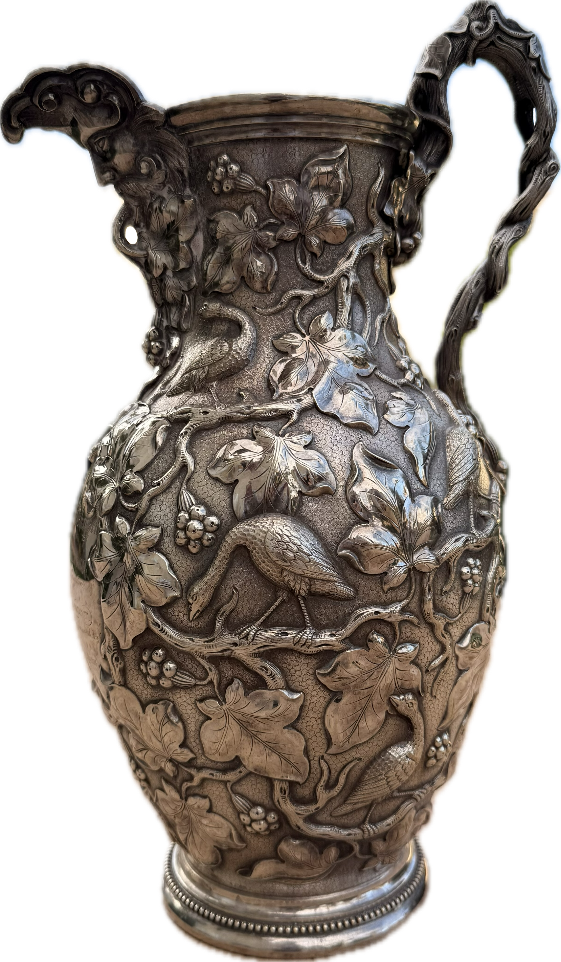
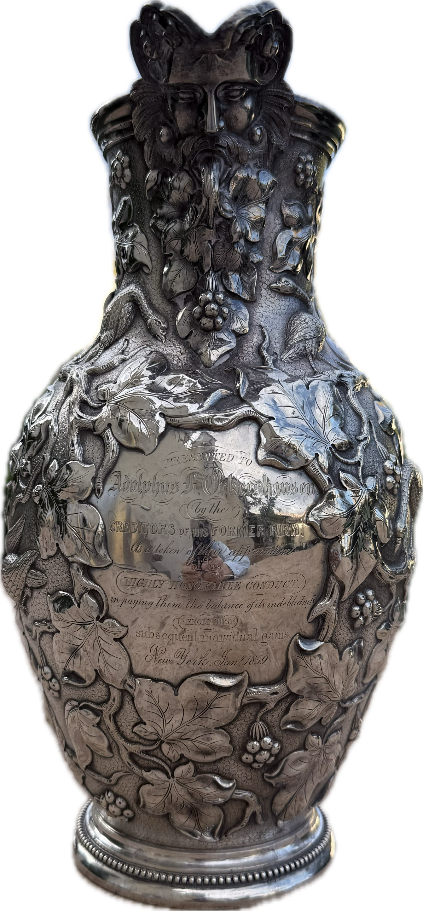
Adolphus Ockershausen died in 1877 at the age of 63, and his New York Times obituary prominently noted this tale of honorable behavior. At the time of his passing, Ockershausen Brothers ranked among the leading sugar refiners in the United States and Adolphus’ success and reputation had led to leadership positions across an array of activities, from banking to the Staten Island Railroad to the volunteer fire department and other charities. With an estate of $100,000, he would have been within the top .1% of Americans, equivalent to a personal net worth between $50 and $100 million today.
My wife and I purchased the Ockershausen pitcher about twenty years ago and plan to keep it in good condition for future owners. As a finance executive steeped in the importance of integrity, I jumped at the rare opportunity to own such a meaningful and rare memento to business ethics.
It is a given that bad actors (business and otherwise) stand out and make news, just as it is that we are more likely to recall investment losses and mistakes than we are to relish investment wins and accomplishments. But, as we begin 2026, I’d like to remind readers to take comfort in knowing that the vast majority of us are honest and well intentioned, which is at the center of why our free enterprise system works and has created the highest living standards in the world.